Improving sea-level reconstructions by precisely dating alteration phases in highly altered corals. Methods: micro-sampling, MC-ICP-MS, trace-element screening.
More
Welcome
Marcos Salas-Saavedra, PhD — Isotope Geochemist | Founder and Scientific Director, SPICe Lab (Chile)
Isotope geochemist and founder and scientific director of SPICe Lab SpA (Lanco, Los Ríos, Chile, founded 2025). PhD in geochemistry, The University of Queensland. Postdoctoral Research Associate, Princeton University, January 2023–September 2025. I work on carbonate systems, U–Th geochronology, coral paleoclimate (including ENSO), and meteoric calcite, integrating LA-ICP-MS/MC-ICP-MS with Python-driven analysis.
U–Th DatingCoral GeochemistryLA-ICP-MS
PaleoclimateSea Level
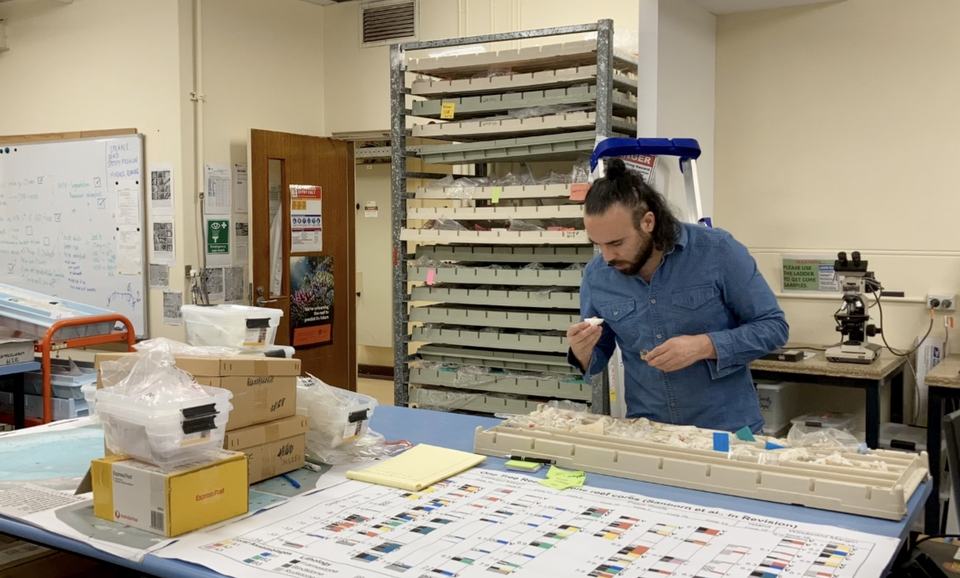
About
My research bridges geochronology, geochemistry, and paleoclimate. I investigate past climate and sea-level variability using coral archives and carbonate systems, with expertise in U–Th geochronology, trace-element geochemistry, and multi-instrument workflows (LA-ICP-MS, MC-ICP-MS, LIBS, micro-CT/3D, SEM). I combine rigorous laboratory methods with Python-based data processing, time-series analysis, and QA/QC for low-level trace-element detection (including REEs).
Read extended bio
I’m an isotope geochemist who integrates geochronology, analytical chemistry, and climate reconstruction to understand how reef systems and sea level have changed through time. From January 2023 to September 2025 I was a Postdoctoral Research Associate at Princeton University, where I investigated past climate and sea-level variability using coral archives and other carbonate materials. My technical expertise spans U–Th geochronology; radiogenic and stable isotope analysis; trace-element and REE geochemistry; and advanced instrumentation including LA-ICP-MS, MC-ICP-MS, LIBS, micro-CT/3D imaging, and SEM. I develop and apply high-precision methods to challenging carbonate samples—especially meteoric calcite phases in highly altered fossil corals—to refine sea-level reconstructions. I also build Python-based workflows for data reduction, time-series analysis, and rigorous QA/QC at ultra-low detection levels, enabling me to extract seasonal to multi-decadal signals (e.g., ENSO) from coral proxy records. My portfolio includes instrument optimization, automated column chemistry (prepFAST MC), and gravimetric spike preparation to improve dating accuracy. I’ve led and supported field campaigns on the Great Barrier Reef and in the southern Caribbean (Curaçao), collecting materials for geochronology, carbonate chemistry, and stable-isotope studies of reef metabolism. My publications include work in Quaternary Science Reviews, Chemical Geology, and Sedimentary Geology, and I’ve presented at major meetings such as AGU. At Princeton I mentored graduate students in advanced analytical techniques and contributed to laboratory operations and instrument maintenance planning. I earned my PhD in geochemistry from The University of Queensland (UQ), in Geochemistry and Geochronology, and hold a Licentiate and a Bachelor’s in Biological Sciences from the Austral University of Chile. My training was supported by competitive funding, including Chile’s CONICYT Scholarship and internal research support during the Princeton appointment. In 2025 I founded SPICe Lab SpA in Lanco, Los Ríos, Chile, where I am founder and scientific director. SPICe Lab does not have its own laboratory: isotope analyses are run at The University of Queensland. Its lines include SPICe Agro (https://agro.spicelab.cl), which takes that science into agriculture and gardens in southern Chile, and the Huerto app (https://huerto.spicelab.cl), for planning beds, keeping photo records, and tracking weather, harvests, and irrigation from a phone.
Highlighted Work
Seasonality extraction and anomaly detection from Mg/Ca and Li/Mg time series to study ENSO variability with robust signal processing.
MoreFounder and scientific director. SPICe Lab SpA was founded in 2025 in Lanco, Los Ríos, Chile. It does not operate its own laboratory; isotope analyses are run at The University of Queensland.